
Spring might be taking its time, but landscaping season always shows up eventually. If you’re planning to add new trees, shrubs, or large plantings this year, it’s worth thinking beyond curb appeal. Where you plant, and what you plant, can affect how water drains around your home and how soil behaves near your foundation.
Before you bring home that new shade tree or hedge line, take a moment to consider the long-term impact on your foundation. The right placement can help protect your home; the wrong placement can contribute to moisture problems, cracking, and drainage issues down the road.
Finding the Right Tree for Your Foundation
“Trees have very specific site requirements that should be considered before they are given a new home,” John Lang writes for the Arbor Day Foundation.
In addition to sunshine available, soil type and weather, one key factor to consider is your yard’s drainage. “If your yard is sloped, trees and plants at the bottom of your yard will retain more water and may even be prone to drainage issues. Keep this in mind when deciding on the water needs of your future tree,” Lang says.
Another key factor is required growing space. Take a look at where your house is located on your lot, other structures such as decks and sheds, utility lines above and below the ground, and other plants and trees.
“Poor placement can result in roots or branches too close to structures, driveways or sidewalks,” Lang says. This could lead to foundation cracks, damage and leakage in the future.
“You could also run into problems with underground plumbing, or overhead or underground power lines,” he adds.
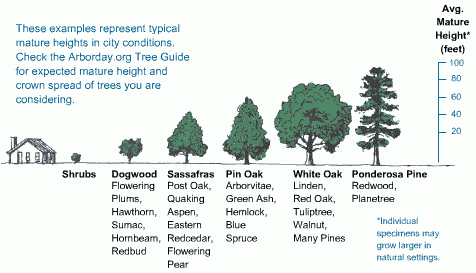
The Arbor Day Foundation offers a sizing guide (right) that shows the growth heights for certain trees.
If you’re a planting tree to create shade for your house and lower energy bills, position it so it will block the late afternoon sun, according to Jim at YourGardenSanctuary.com. Since afternoon sun shines at a lower angle, “In order to get the most useful shade on a house, you should place a shade tree about 20 feet from the house,” Jim says.
Three big problems can arise if you plant a tree too close to your house:
- You can create hazards, such as branches falling on the house.
- Roots exerting pressure on the foundation can cause mechanical damage.
- Soil moisture can fluctuate, causing soil to contract and expand and put pressure on the foundation.
What Not To Plant
Roots for certain types of trees grow so aggressively that they shouldn’t be planted even 20 feet or more from your home, according to Jim. They include:
- Silver Maple (Acer saccharinum): Dense and shallow roots can grow into and invade foundations.
- Norway Maple (Acer platanoides): These trees are notorious for lifting and shifting concrete because their roots are near the surface.
- Cottonwoods, Aspens and Poplars (Populus): The wide-spreading root systems of these trees seek out water wherever they can. They are one of the worst to plant near homes.
- Willows (ix spp.): Willow roots will invade your house, water systems and septic systems. The roots grow deep to seek moisture and anchor trees.
- American Elm (Ulmus americana): American Elms have deep roots that often clog sewer lines and drains. These should also be kept well away from anything related to water.
- Two others to avoid near your foundation: Black Alder (Alnus glutinosa) and Black Locust (Robinia pseudoacacia).
What You Should Plant Near Your House
So what do experts recommend for planting near your house and foundation? Nikki Phipps at Gardening Know How makes these suggestions.
- Tree-form evergreen shrubs such as wax myrtle, ligustrum or cherry laurel are good for small areas. Keep these at least 5 feet from the house.
- Low-growing shrubs like yew, juniper, boxwood and holly. Allow at least 3 feet between plants to prevent overcrowding.
- Small ornamental trees, such as dogwood, redbud, Japanese map, crepe myrtle and star magnolia.
- Vining plants for ground covers, such as liriope, ivy, creeping juniper, periwinkle and sweet woodruff. Keep these at least 12 inches from the foundation.
Resist the temptation to plant things right next your house to hide your foundation, adds Mike McGrath at Gardens Alive!
“You should always leave a foot of open space around the foundation to prevent moisture build up that can lead to mold and damaging dampness (and to avoid giving insects like carpenter ants and termites direct access to your home),” McGrath says. “Distance is good for the health of the house — and the plants.”
His rule of thumb for next-to-foundation plantings is this: “Take half of a plant’s ‘final width’ and add a foot; that’s close to a perfect rule for most plants.”
Call Dry Basement for Help With Your Foundation
Landscaping should improve your home, not create future foundation or basement problems. If you’re not sure whether your yard’s slope, soil conditions, or planting plans could lead to water pooling near the house, contact Dry Basement for help. Our team can assess drainage and moisture risks and recommend next steps to keep your foundation protected while you plan your outdoor upgrades.
FAQs About Tree Placement on Your Foundation
Can tree roots crack or damage my foundation?
Yes. Some tree species develop aggressive, wide-spreading root systems that can push against foundation walls, patios, driveways, and sidewalks. Even when roots do not directly “break” concrete, they can contribute to soil movement and pressure changes around your home. If you are noticing new cracks, sticking doors, or uneven floors, Dry Basement® can inspect your foundation and recommend repair options.
How far should trees and shrubs be planted from a house foundation?
It depends on the mature size of the plant and the type of root system. As a general rule, larger shade trees need much more space than small ornamental trees or low-growing shrubs. Planting too close can lead to root pressure, moisture retention near the foundation, and drainage issues. If you are unsure about your yard’s slope, soil conditions, or safe spacing, Dry Basement® can evaluate drainage and help you avoid landscaping choices that increase foundation risk.
What should I do if water pools near my foundation after rain?
Pooling water is a warning sign because it can saturate soil around the foundation and increase the chance of cracks, leaks, or basement moisture. The best next step is to identify why water is collecting, common causes include poor grading, short downspouts, clogged or missing drainage, and compacted soil. Dry Basement® can assess the problem and recommend solutions such as grading corrections, downspout extensions, and drainage improvements to help keep water away from your home.